
THE ORIGIN
Espoo, Finland. 2020.
A motorcycle fair. A BMW R9T behind glass.
A spark that refused to go out.
It did not begin with a plan.
It began with recognition, the particular, involuntary response a person has when they encounter something that reflects their own standards back at them before they have fully articulated what those standards are. A 2020 Helsinki motorcycle fair. A BMW R9T in the BMW display. A friend’s offhand comment: that’s Café Racer style.
Before that moment, the words meant nothing. After it, an entire world opened.
That evening, the research began. It did not stop for months.
The Machine That Started Everything
BMW Motorrad was born from refusal.
After the First World War, the Treaty of Versailles prohibited Germany from manufacturing aircraft engines, the business BMW had been built on. Rather than dissolve, the company pivoted. In 1923, BMW launched the R32 at the Paris Motor Show: a horizontally opposed twin-cylinder engine, shaft drive, and a frame architecture that was genuinely unlike anything else on the road. The boxer engine layout, two cylinders opposed horizontally, air-cooled, the mechanical logic exposed rather than concealed, was not a styling decision. It was an engineering conviction.
That conviction has never been abandoned.
The R-Series Airheads, produced until 1995, when the air-cooled boxer architecture gave way to the oil-cooled generation that followed, represent the purest expression of that original conviction. No water jacket. No concealment. The engine as the visual and mechanical center of the machine, cooled by the air it moves through, maintained by any competent operator with available tools. An architecture designed for permanence rather than replacement cycles.
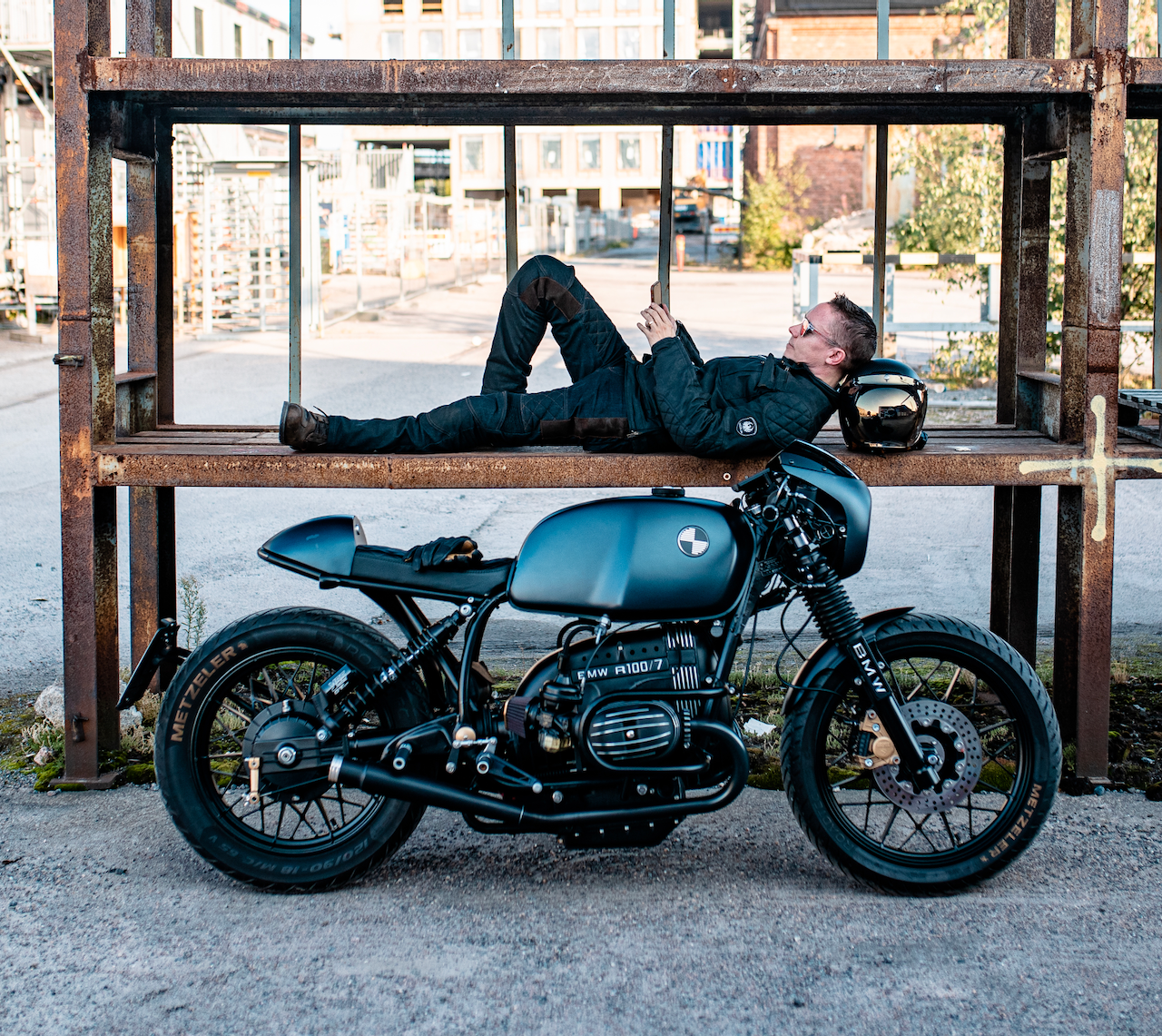
The 1978 R100/7 is an Airhead. It was built when BMW was still making motorcycles the way BMW had always made motorcycles, with the assumption that the machine would outlast the decade, the owner, and possibly the century.
This is the machine that became the founding object of Dark Shadow Garage.
A 1978 R100/7. Originally commissioned by the Finnish Police. Forty years of documented service followed by years of storage. The seller confirmed the engine ran. He also confirmed the carburetors leaked and starting was unreliable. Neither fact was a deterrent. The plan was never to preserve what existed. The plan was to find out what was underneath it.
The borders of Uusimaa were closed. A pandemic had arrived and settled in without a departure date. A trailer was arranged. The bike arrived in the garage on the first day the lockdown ended.
The project had begun.
The Standard Is Set in a Moment of Refusal
A restoration reveals things. Some of them are expected, forty years of mechanical use leaves evidence everywhere, in worn bearings and degraded gaskets and carburetor passages that no longer flow cleanly. These were anticipated. They were the reason the bike had been acquired rather than a newer, cleaner machine. A project requires problems. Problems are where decisions are made. Decisions are where a standard either holds or it doesn’t.
The unexpected revelation arrived when the final drive was opened.
The crown gear, the precision-cut assembly that translates engine output into rear wheel rotation, had been damaged. Not worn. Damaged. A previous impact, small enough to leave no visible record anywhere else on the machine, had cracked the gear teeth. The original ratio was 2.91. A replacement at that specification did not exist anywhere on earth. The search covered the United States, Europe, and Asia. Every channel. Every warehouse. Every parts network for vintage BMW motorcycles across three continents.
Nothing.
The alternative was a 3.00 ratio unit from an R100RT, a touring specification, engineered for long-distance comfort rather than performance. It was available. It would have functioned. It was the wrong answer.
The search continued.
In the BMW racing parts literature, a third ratio existed, a 2.75, documented as the specification used on BMW’s own factory race machines in the 1970s and 1980s. Almost no information. No known availability. A specification that existed in documentation but apparently nowhere else.
One warehouse. Germany. A single unit identified by serial number in inventory records that had not been accessed in years.
The correct part was acquired. The correct ratio was installed. The machine was built to the specification it deserved.
“That decision is the founding document of Dark Shadow Garage. Not the completed motorcycle. Not the finished paint. The refusal to accept a ratio that was available when the correct ratio existed and could be found.”
What the Build Required
Everything was disassembled. Every component was bagged, labelled, and documented. Approximately one thousand photographs were taken across the duration of the project. Nothing was assumed. Nothing was approximated.
The frame, rims, and structural components went to sandblasting and powder coating. The engine and gearbox were completely rebuilt, new bearings, gaskets, springs, pistons, cylinders. The cylinder heads were shipped to Germany for valve replacement and precision machining. A Siebenrock replacement kit was specified for the new cylinders, German engineering applied to a German machine, at the specification the machine was originally capable of before emissions regulations reduced the compression ratio for the American market.
The electrical system was replaced entirely. Not repaired. Replaced. A Motogadget M-Unit was selected as the control architecture, Bluetooth connectivity, smartphone integration, configurable turn signal and brake light behaviour. A digital speedometer. The bike’s electronics brought into the current century without compromising the mechanical purity of the machine it was attached to.
The color system was decided early and did not change. Two primary colors and one accent, the 2+1 rule that governs DSG aesthetics to this day. Obsidian Black as the primary substrate. BMW Individual Frozen Arctic Grey Metallic Matt, a color developed for the M-Series car range, carrying the word Arctic as a deliberate nod to the northern environment in which this machine was being built. Brushed gold as the accent frequency. Brake calipers. Selected details. The minimum required for maximum effect.
The engine components required heat-curing after painting. There was no oven in the garage. There was a Weber grill. Baking paper was laid down. Components were placed inside. The lid was closed. One hundred degrees Celsius. One part at a time. The process worked.
“This is what the Standard looks like in practice. Not laboratory conditions. Whatever conditions exist. The outcome does not change.”
The Machine Becomes a Philosophy
The paint arrived finished and correct. The tank was sealed. Fuel was added. The first start of a completely rebuilt 1978 BMW R100/7 Airhead, transformed into Dark Shadow, a Café Racer built to the philosophy of a race machine, happened in a garage in Espoo, Finland, in the winter of 2021.
The bike ran.
What had begun as a pandemic project had produced something that had not existed before. Not merely a custom motorcycle, the custom motorcycle world is crowded with competent work and occasionally with extraordinary work. What this produced was a methodology. A proven set of principles for how to approach any object, any system, any problem:
Establish the correct specification. Accept no substitution. Source the correct answer regardless of the difficulty of finding it. Document everything. Maintain what you build. Hold the standard above the convenience of the moment.
Dark Shadow ran. The Standard had been set.
What Followed
The Instagram account @darkshadowgarage was established before the build was complete, the audience following the project through informal channels needed a home. The first customer arrived unsolicited. An Instagram follower contacted the garage, came to Espoo, looked at the finished machine, and commissioned a second build, a 1973 R90/6, Café Racer Bobber specification. He had not asked for a sales pitch. The work had spoken before any conversation began.
This is how the DSG Standard propagates. Not through marketing. Through evidence.
The same logic that governed the motorcycle build now governs the EDC ecosystem. The carry system. The blade gallery. The layering protocol. The Lab maintenance schedule. Every object that carries the DSG certification has passed the same question the crown gear sourcing answered in 2020.
“Is this the correct answer? Not the available answer. The correct one.”
The Architect
Tito Toivola. Espoo, Finland.
The career began at the front line, direct sales, customer service, the daily discipline of understanding what a person actually needs versus what they say they want. That foundation was never abandoned. It simply scaled.
What followed was twenty-five years of progressive responsibility across the most demanding sectors of enterprise technology, telecommunications, IT infrastructure, cloud transformation, AI-driven service architecture. The roles changed. The underlying discipline did not. Every position required the same capability: take a system of extraordinary complexity, identify where it fails under load, and build the correct architecture before deployment rather than discover the failure modes during operation.
Leadership of enterprise accounts at the CxO level. Management of global virtual teams. P&L ownership for business units operating at scale. The creation of new service models from the ground up, not iterations on existing frameworks but genuinely new approaches, built from first principles, deployed successfully, and adopted as standard practice by the organizations that commissioned them. Co-founder of a software company. Currently driving AI and data-driven transformation across Nordic organizations.
The thread running through all of it is not the technology. Technology changes. The thread is the methodology: establish the correct specification, eliminate the failure modes, hold the standard above the convenience of the moment, and build for permanence rather than for the current cycle.
The garage in Espoo was not a departure from that work.
It was the same methodology applied to a 1978 BMW boxer engine, a cracked crown gear that three continents could not supply in the correct specification, a Weber grill repurposed as a paint-curing oven, and a philosophy that has not changed since the correct final drive ratio was installed and the machine started for the first time.
The domain changed. The standard did not.
Dark Shadow Garage. Forged in Winter. Built for Centuries.
The motorcycle is on the road.
The Standard is operational.
The ecosystem is documented below.