
THE MOTORCYCLE
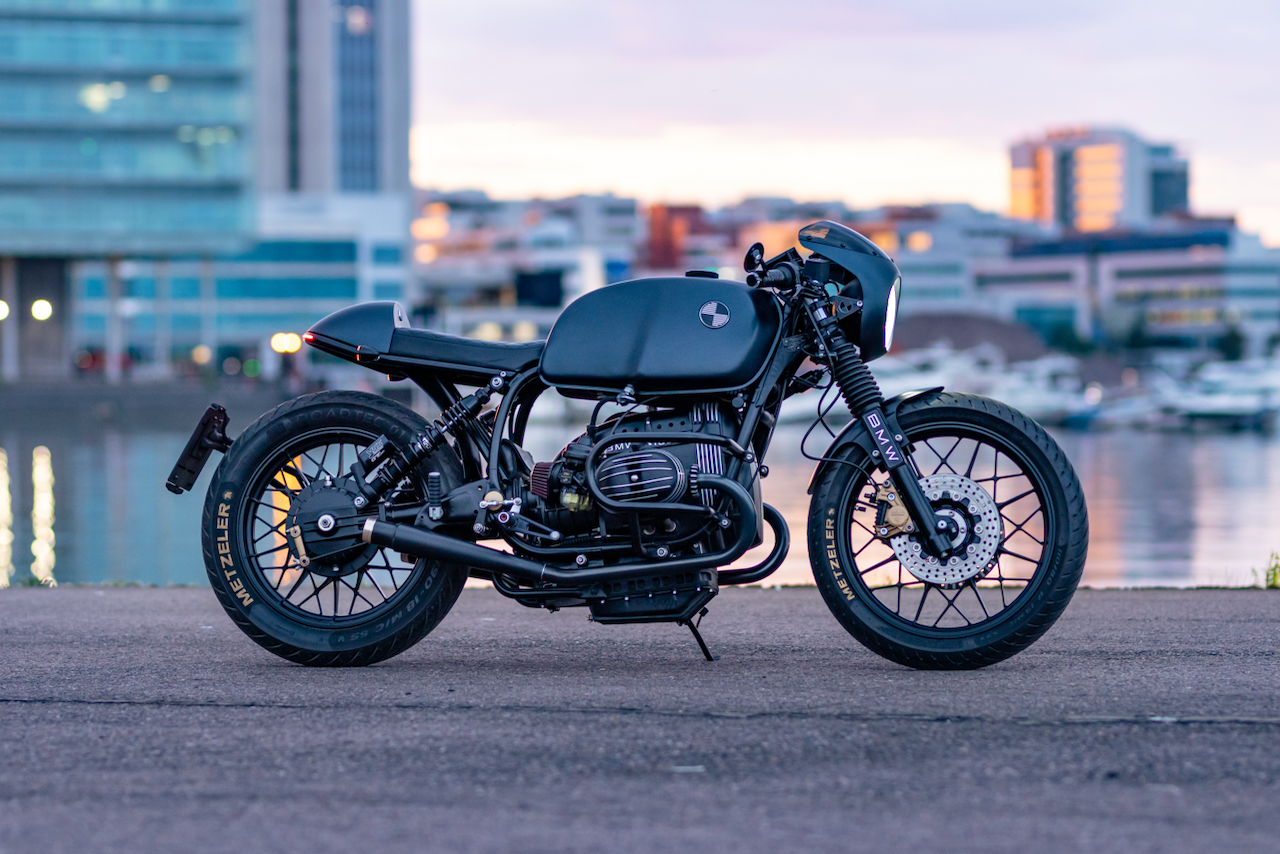
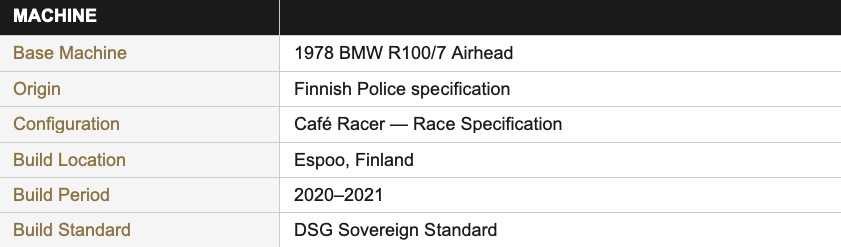
1978 BMW R100/7 Airhead
Café Racer — Race Specification | Espoo, Finland. 2020–2021.
“This machine did not arrive as a project.
It arrived as a question.
Everything that follows is the answer.”
Acquisition
The search began before the motorcycle did.
The decision to build a Café Racer from a BMW Airhead was made at a Helsinki motorcycle fair in early 2020. Not impulsively, after months of research into the architecture, the heritage, and the available donor machines. The R-Series Airhead was the only correct starting point. An air-cooled boxer engine produced until 1995, with a mechanical philosophy unchanged in its fundamentals since 1923. Exposed engineering. Accessible maintenance. An architecture designed for permanence.
The specific machine was a 1978 R100/7. Former Finnish Police specification. Forty years of documented operational service before retirement and storage. The seller’s confirmation that the engine ran was noted. The leaking carburetors and unreliable starting were not deterrents, they were the expected condition of a machine that had earned its age honestly.
The borders of Uusimaa were closed when the purchase was made. A trailer was arranged for the first day the lockdown permitted travel.
The machine arrived in the garage. The work began.
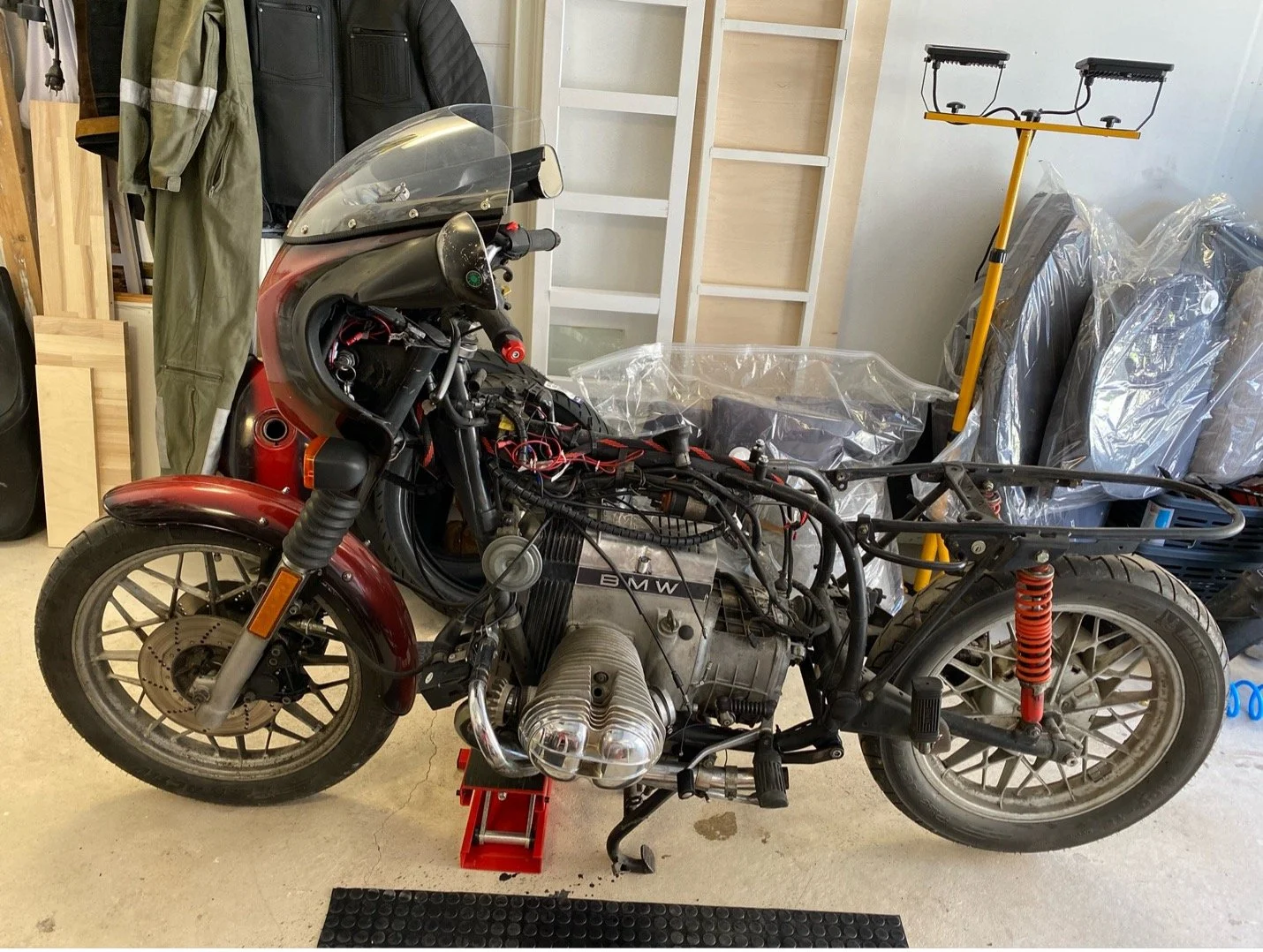
The machine as acquired, complete, unmodified, original Finnish Police specification. Before any disassembly begins.
Disassembly & Documentation
Everything came apart. Every component from engine, gearbox, frame, electrical, bodywork was disassembled, catalogued, bagged, and labelled. Nothing was assumed serviceable. Nothing was assumed failed. Each element was assessed on its own terms against the specification it was designed to meet.
Approximately one thousand photographs were taken across the duration of the project. This was not sentimentality. It was system architecture, a complete visual record of the machine’s condition at every stage, every decision documented in the state that prompted it, every assembly recorded in the sequence that produced it. A machine this age carries no service history that can be trusted completely. The only reliable record is the one you make yourself.
The documentation standard established during this build is the same standard applied to every subsequent DSG project.
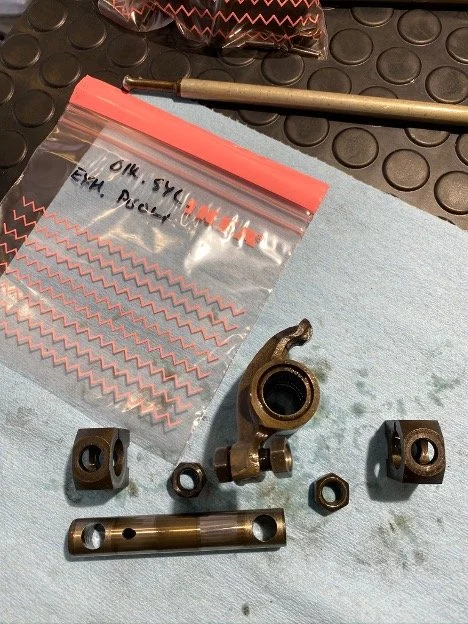
Disassembly in progress, components laid out, labelled, the systematic order of the process visible. The garage as engineering environment
The Decision That Founded Everything
When the final drive was opened, the crown gear revealed a hairline crack in the gear teeth. Not wear. Impact damage, historic, small, invisible from the outside but structurally decisive. The original ratio at 2.91 was unavailable at that specification anywhere on earth. Three continents. Every vintage BMW parts network. Every specialist warehouse. Nothing.
A replacement existed at 3.00 - the touring ratio from an R100RT. Available. Functional. Incorrect. The touring specification was engineered for long-distance comfort, not for a machine being rebuilt to Café Racer geometry and race-derived ergonomics. Installing it would have been a permanent compromise embedded in the foundation of the build, invisible to any observer, known only to the machine and the builder.
The search continued.
BMW’s factory racing documentation referenced a 2.75 ratio, the specification used on the factory race machines of the 1970s and 1980s. No commercial availability anywhere. A single inventory record in a German parts warehouse, identified by serial number in records that had not been accessed in years.
The 2.75 was acquired. Installed. Correct.
“This decision is the founding specification of Dark Shadow Garage. Every subsequent decision in this build, and in every build, every EDC certification, every maintenance protocol that followed, was held to the same standard established here.”
Engine & Drivetrain
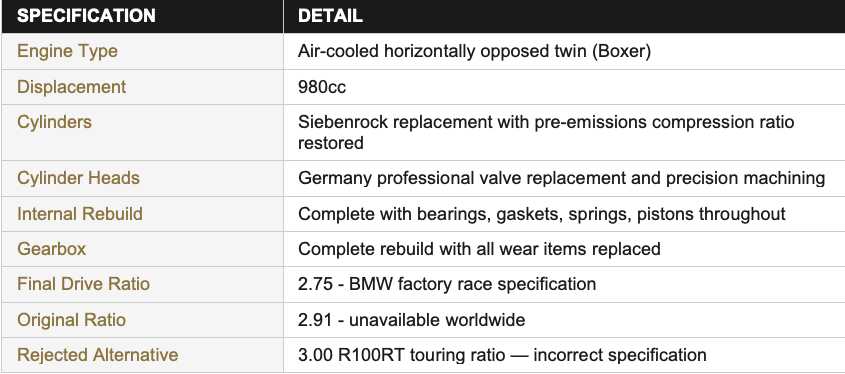
The engine was completely rebuilt. This is not a figure of speech, every internal component was addressed.
New bearings throughout. New gaskets. New springs. New pistons. New cylinders. The cylinder heads were removed and shipped to Germany for professional valve replacement and precision machining, a decision made not because local capability was unavailable but because the correct capability was in Germany and the specification required it.
The replacement cylinders were Siebenrock units, a German manufacturer producing components to the original BMW engineering specification, in some cases exceeding the factory tolerance. The Siebenrock kit restores the compression ratio to the original pre-emissions specification at 9.5 - a ratio that had been reduced for the American market in the 1970s and never restored in the factory configuration. The correct compression ratio was installed.
The gearbox was rebuilt in parallel with the engine. Every wear item replaced. Every tolerance verified.
The final drive carries the 2.75 race ratio. This is not a performance modification. It is the correct specification for this machine in this configuration.
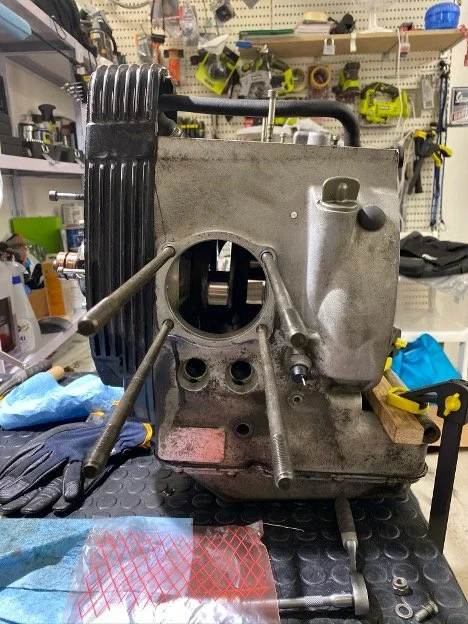
Engine cases open, internals visible, the mechanical architecture of the boxer exposed. The engineering made legible.
ENGINE & DRIVETRAIN — SPECIFICATION
Electrical System
The original electrical system was removed in its entirety. Not repaired. Removed.
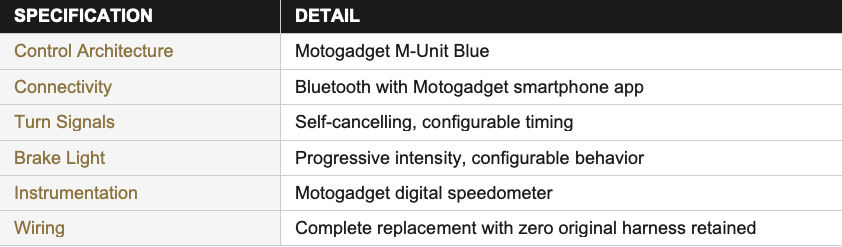
A Motogadget M-Unit Blue was selected as the control architecture. The M-Unit is the professional standard for custom motorcycle electrical integration, a centralized control module that manages all circuits through a single, clean, fully documented system. Bluetooth connectivity. Smartphone pairing via the Motogadget app. Configurable turn signal behaviour, self-cancelling, with adjustable timing. Configurable brake light behaviour, progressive intensity under sustained braking. Every function of the electrical system defined, adjustable, and documented.
A Motogadget digital speedometer was integrated, accurate, minimal, weatherproof, and consistent with the clean instrument aesthetic of the build.
The rationale for complete electrical replacement rather than repair was architectural. A 1978 wiring harness, regardless of its condition, carries the assumptions of 1978 electrical engineering. Those assumptions do not interface cleanly with modern instrumentation, modern control logic, or a maintenance standard that requires every system to be fully documented and reproducible. A new system, built to a known specification, is more reliable, more maintainable, and more honest than a restored original.
ELECTRICAL — SPECIFICATION
Chassis & Bodywork
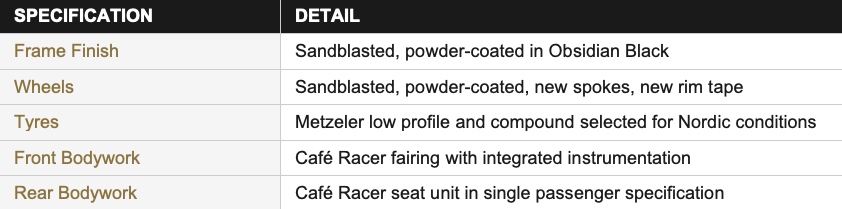
The frame was completely stripped, sandblasted, and powder-coated. Every surface returned to bare metal, inspected for structural integrity, and finished to a consistent specification before any component was reattached.
The wheels were rebuilt to the same process, stripped, sandblasted, powder-coated. New spokes. New rim tape. Metzeler tyres selected for the combination of profile geometry appropriate to the Café Racer stance and compound performance in the wet Nordic conditions the machine would operate in.
A Café Racer front fairing was specified for the conversion, not for aerodynamic function at road speeds, but for the visual and ergonomic coherence of the Café Racer architecture. The fairing houses the instrumentation and establishes the forward geometry of the machine’s silhouette.
Rear bodywork was replaced with a Café Racer seat unit, integrated tail, minimal profile, consistent with the single-passenger operational specification of the build.
CHASSIS & RUNNING GEAR — SPECIFICATION
Finishing System
The color system was decided before the disassembly was complete. It did not change.
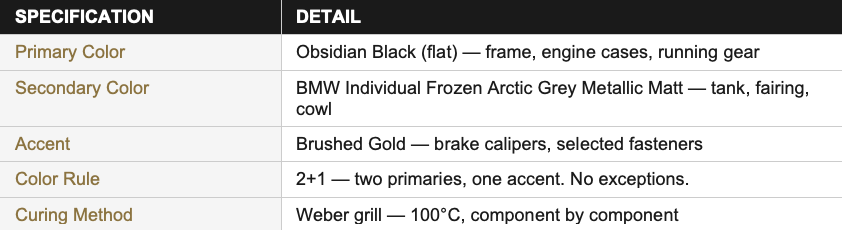
Two primary colors. One accent. The 2+1 rule that has governed every subsequent DSG aesthetic decision.
“Primary substrate: Obsidian Black. Frame, engine cases, fork legs, wheels. The structural mass of the machine rendered in flat black, not gloss, which reflects and dates the finish, but flat, which absorbs light and removes the machine from any specific era.”
“Secondary color: BMW Individual Frozen Arctic Grey Metallic Matt. Tank, fairing, seat cowl. A color developed for the BMW M-Series automobile range, factory specification, carrying the word Arctic as a deliberate and accurate reference to the latitude at which this machine was built.”
“Accent: Brushed Gold. Brake calipers. Selected fasteners. The minimum presence required for maximum effect. Not decoration, frequency.”
The engine components required heat-curing after painting. A conventional oven was unavailable. A Weber grill provided the required temperature, one hundred degrees Celsius, one component at a time, baking paper as the substrate. The process worked. The finish held. The Standard does not require optimal conditions. It requires the correct outcome.
FINISHING SYSTEM — SPECIFICATION
COMPLETE BUILD SPECIFICATION
The Dark Shadow at Keilaranta Helipad, Espoo, Finland.
What This Machine Is
Dark Shadow is not a restored motorcycle. Restoration implies returning an object to its original condition. This machine was not returned to anything, it was taken beyond its original specification in every system where a superior specification existed and could be sourced.
The engine runs at the compression ratio it was designed for before regulatory compromise. The final drive operates at the ratio BMW’s own race engineers specified for performance rather than the ratio the road-going machine was born with. The electrical system operates with a clarity and reliability that the original 1978 architecture could not have achieved. The finish was designed to be timeless rather than period-correct, to remove the machine from any specific decade and place it simply in the category of things built to last.
It is a 1978 machine. It operates to a 2021 specification. The gap between those two dates is the work.
“The Standard does not restore. It refines.”
The First Customer
Before Dark Shadow was complete, the work had already found its audience.
An Instagram follower had been watching the build through the project documentation. He came to Espoo. He saw the finished machine. He commissioned a second build without negotiation, without a formal pitch, without a portfolio presentation beyond the machine standing in front of him.
A 1973 BMW R90/6. Café Racer Bobber specification. The work spoke before any conversation began.
That machine became Project Dark Cray. The Standard that built Dark Shadow built Dark Cray. The methodology does not change between projects, only the specifications do.
Dark Cray is documented separately.
“The machine that set the Standard is on the road.
The Standard it set is documented above.
The ecosystem it founded is below.”