
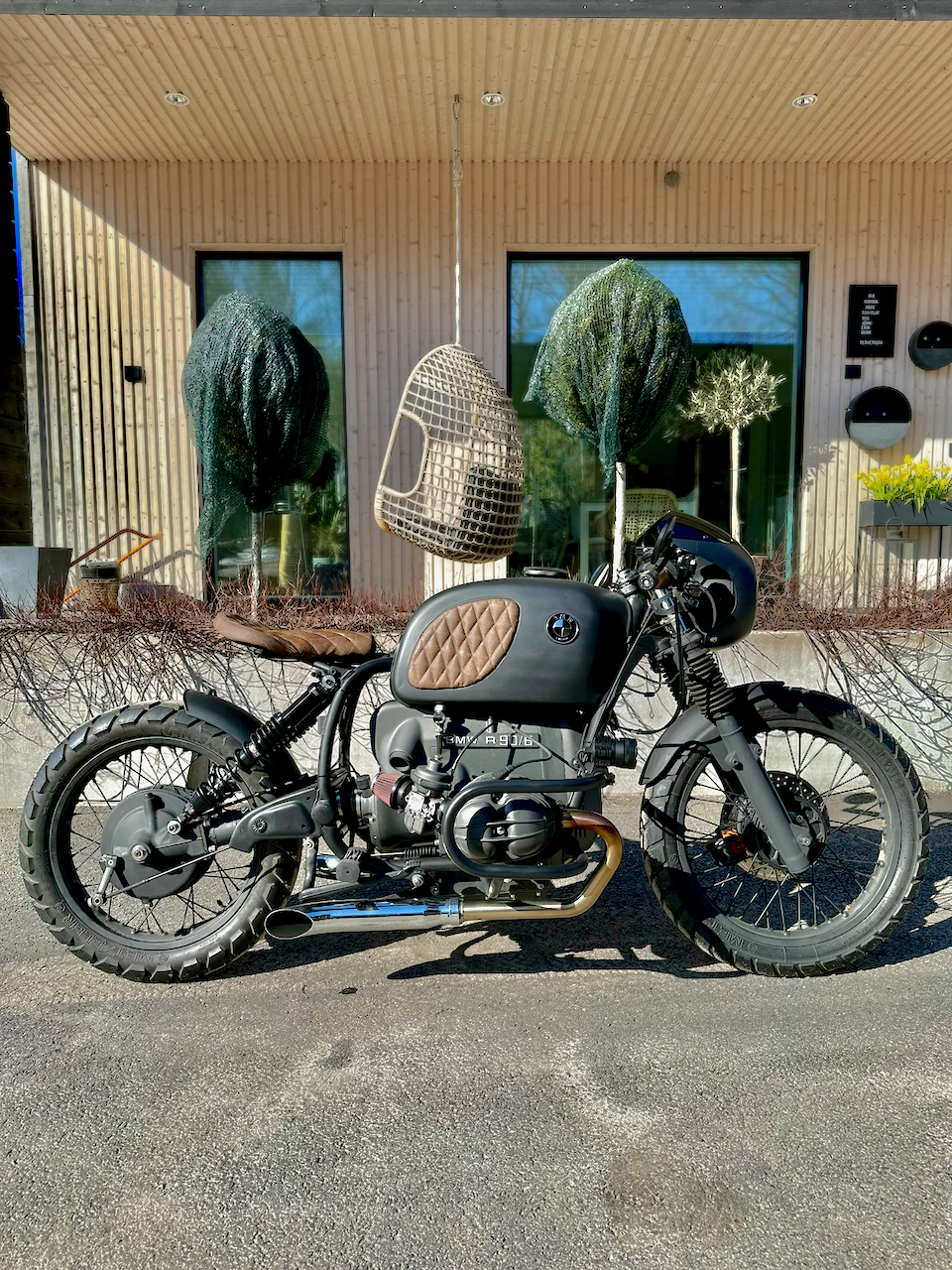
THE DARK CRAY
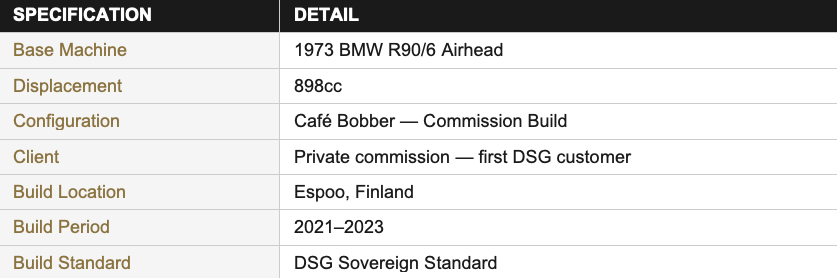
1973 BMW R90/6 Airhead
Café Bobber — Commission Build | Espoo, Finland. 2021–2023.
“The first build proved the Standard.
The second build tested it.
The Dark Cray passed.”
The Commission
Dark Shadow was not yet finished when the second project began.
An Instagram follower had been watching the R100/7 build through the documentation, the disassembly, the decisions, the discipline made visible post by post. He came to Espoo. He saw the machine. He did not ask for a proposal or a timeline or a price comparison. He asked if the same work could be done for his 1973 BMW R90/6.
The answer, after a few days of consideration, was yes.
This was not a commercial calculation. It was the recognition that a second build would deepen what the first had established, more experience, more decisions, more problems that had no precedent to draw from. The methodology would either hold under new conditions or reveal where it needed strengthening. Either outcome was useful.
The machine that arrived was a 1973 R90/6 — an 898cc Airhead, five years older than the R100/7 that became Dark Shadow, carrying fifty years of accumulated history and one critical mechanical failure that had taken it off the road entirely. The gearbox had seized. The owner could not change gears. The bike was unrideable.
That gearbox failure is the reason this story exists at all.
Without it, the owner would not have needed someone to take the project. Without the project, he would not have found the Instagram documentation. Without the documentation, he would not have come to Espoo. The broken spring inside the gear change mechanism — a component smaller than a finger — is the mechanical reason Dark Cray was ever built.
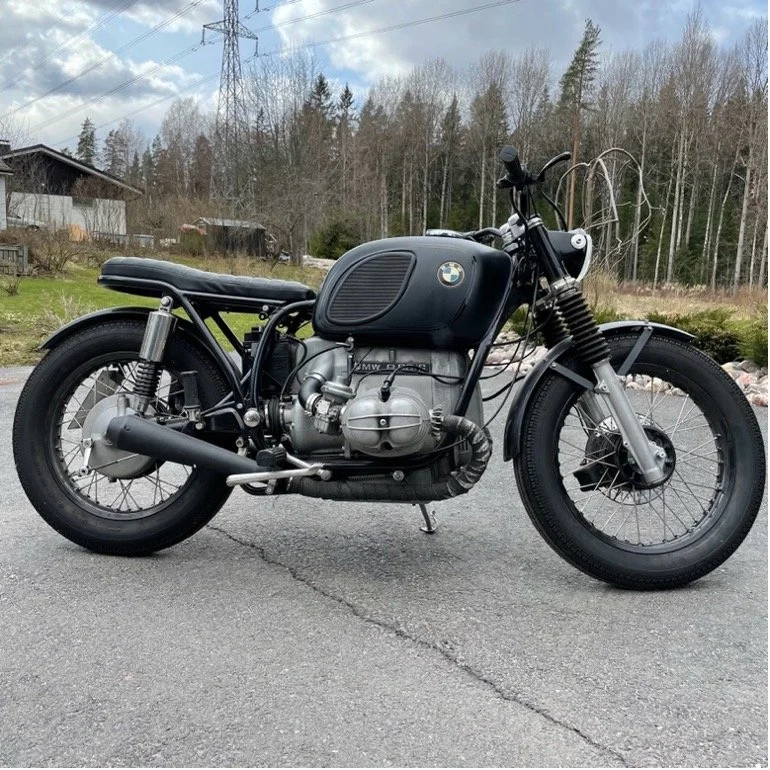
The commission’s starting point — the 1973 BMW R90/6 as it arrived in Espoo
The Design
The configuration was established through a conversation, not a catalogue.
The owner knew he wanted a Bobber aesthetic, the single seat, the stripped silhouette, the visual weight distributed low and rearward. The Café Racer geometry of Dark Shadow was not the brief. This machine would carry a different posture: shorter, heavier in stance, a rider sitting into the machine rather than leaning over it.
The Café Bobber configuration emerged from that brief. The technical precision of the Café Racer approach applied to the Bobber visual language. Both disciplines distilled to their essentials. Nothing present that doesn’t earn its place.
The color system was developed through the same interview process that had produced the Dark Shadow palette. The 2+1 rule was not negotiable, two primaries, one accent, no exceptions. What changed was the specification of those colors, and the specification arrived from an unexpected direction.
The owner smokes cigars.
That single detail, a personal preference, a daily ritual, a sensory reference point that has nothing directly to do with motorcycles, defined the accent color of the entire build. Dark brown. Aged leather. The color of a good cigar resting in an ashtray. Applied to the seat, the tank side plates and hand grips, the three surfaces a rider makes contact with, and nowhere else.
The primary colors came from a different direction entirely. By 2021, Cerakote had entered the DSG material vocabulary, a ceramic-based coating system originally developed for firearms, offering a hardness and chemical resistance that conventional motorcycle paint cannot approach. For a machine that would operate in Finnish conditions, on Finnish roads, through Finnish winters, the performance argument was decisive.
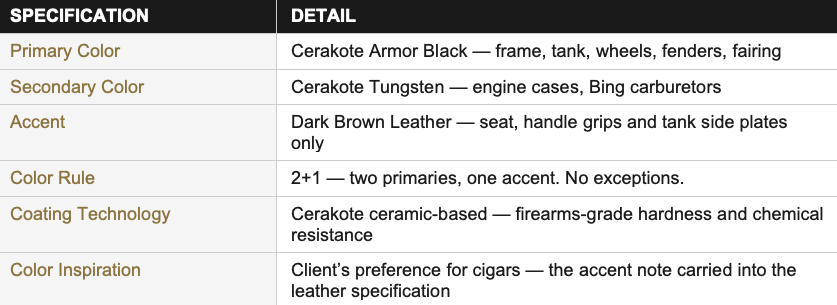
“Primary substrate: Cerakote Armor Black. Frame, tank, wheels, fenders, fairing. The same visual territory as Dark Shadow’s Obsidian Black, the structural mass of the machine rendered in flat, light-absorbing dark, but in a material specification that fundamentally outperforms paint in every operational metric. Harder. More resistant to chemicals, corrosion, and abrasion. Applied at a fraction of the thickness of conventional coatings without sacrificing any of the protection.”
“Secondary color: Cerakote Tungsten. Engine cases and Bing carburetors with open air pods, the mechanical heart of the machine given its own distinct tonal register, slightly warmer and lighter than the Armor Black surrounding it.”
“Accent: Dark Brown Leather. Seat, tank side plates and hand grips only. The cigar note. The single warm frequency in an otherwise cold and precise palette. The minimum presence required for maximum effect.”
The 2+1 rule held. The palette was locked.
The Gearbox — Where It Started
The fault that had taken Dark Cray off the road was the simplest possible mechanical failure.
A small spring inside the gear change mechanism, part of the foot lever assembly that converts the rider’s input into gear selection, had broken. The spring is not a structural component. It does not bear load. It performs one function: returning the lever to the neutral position after each gear change so the next input registers correctly. Without it, the mechanism cannot sequence. The gearbox does not shift.
One spring. An entire machine immobilized.
The spring was replaced. The gearbox was inspected, found repairable rather than requiring complete replacement, and rebuilt to the correct specification. Every wear item addressed. The gear change mechanism restored to factory function, and beyond it, since every component was now at specification rather than at the worn tolerance the machine had accumulated over fifty years.
The gearbox failure that brought this machine into the garage had been resolved. The deeper work could begin.
Engine & The Crank That Changed Everything
The engine was approached to the same standard as Dark Shadow. Complete overhaul. Everything assessed, everything that did not meet specification replaced.
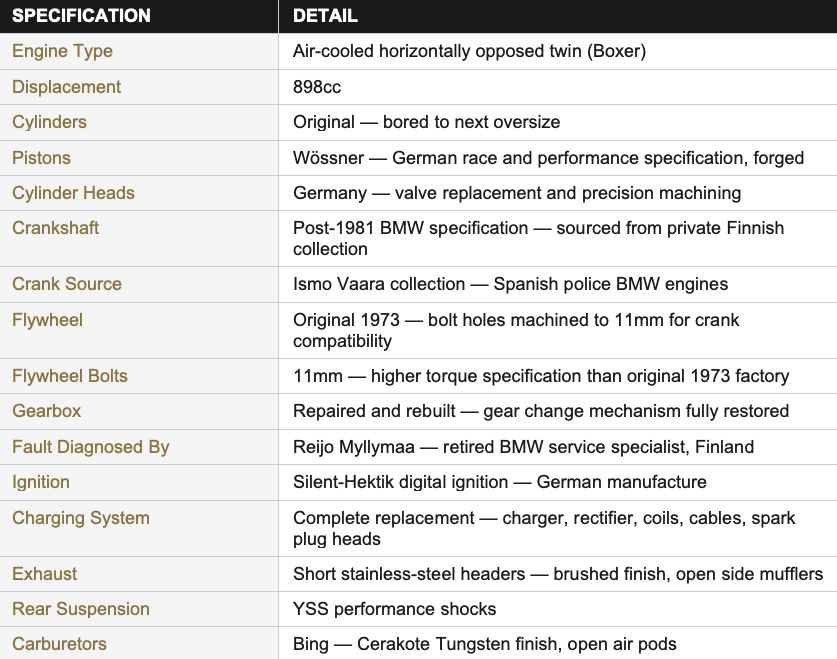
The original cylinders were retained, their condition warranted it, but bored out to the next oversize rather than replaced. New pistons were specified: Wössner, a German race and performance manufacturer, producing forged pistons to tolerances that exceed the factory specification. The same cylinder heads sent to the same German machine shop that had worked on Dark Shadow’s heads, valve replacement, precision machining, the correct specification restored.
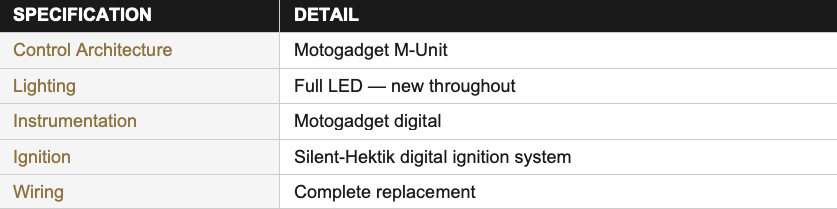
The same Motogadget M-Unit control architecture. New LED lighting throughout. A complete charging system replacement, new charger, rectifier, coils, cables, and spark plug heads. Digital ignition from Silent-Hektik, a German company producing precision ignition systems for vintage BMW Airheads. The same Silent-Hektik system had been fitted to Dark Shadow. The specification was proven.
New rear suspension from YSS, the same performance shock absorbers specified for Dark Shadow. A new exhaust selected to match the Bobber aesthetic: short, direct stainless steel headers with open side mufflers, brushed finish, the mechanical sound made visible in the exhaust geometry.
Then the engine was started for the first time. And the problem that could not have been anticipated announced itself.
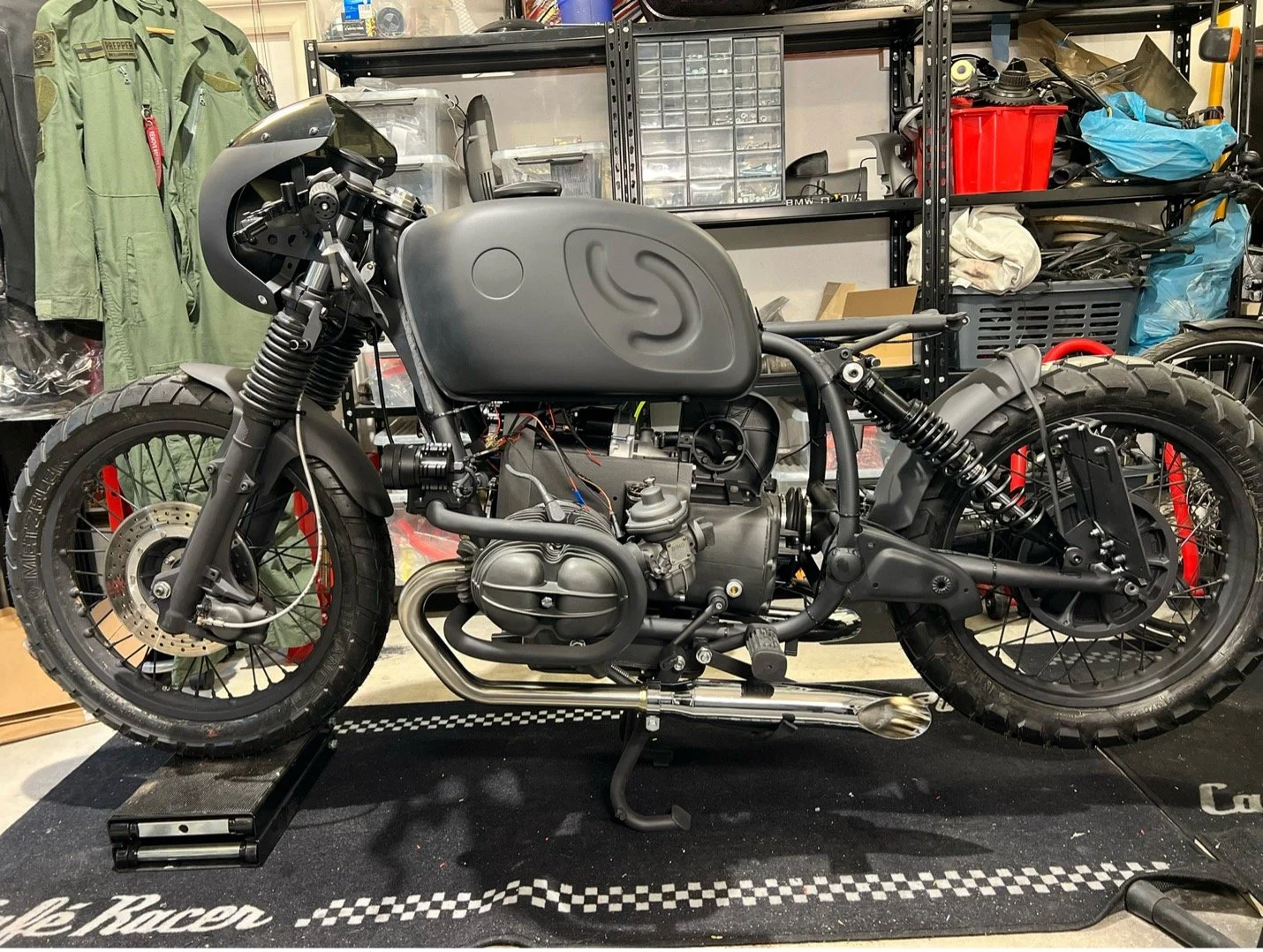
Engine assembled, the Cerakote Tungsten finish on the cases visible against the Armor Black frame. The mechanical architecture of the boxer in the finished color system.
The Crank — A Problem with No Easy Answer
A sound.
Not the sound of a correctly rebuilt engine finding its rhythm. A clinging noise from inside the cases, present, rhythmic, clearly mechanical, source unknown. Carburetors retuned. Timing checked. Every accessible adjustment made. The sound did not resolve.
This is the moment the Standard is tested most severely, not when the work is going correctly, but when something is wrong and the diagnosis requires admitting the limits of available knowledge and finding someone whose knowledge extends further.
That person was Reijo Myllymaa.
Reijo Myllymaa had spent his working life servicing BMW motorcycles in Finland. His company had maintained these machines for decades before his retirement. When the vintage BMW community in Finland needed knowledge that existed nowhere in a manual, it went to Reijo. He agreed to look at Dark Cray in his home garage.
The diagnosis was precise. The sound was coming from the right cylinder. The only way to confirm the source was to remove the right side of the engine completely and examine what was inside.
What was inside: a damaged connecting rod bearing on the right-hand piston. And behind it, connected to it, the crankshaft itself, destroyed beyond serviceable tolerance. The crank was done.
A new crank was required. For a 1973 R90/6, this is not a parts catalogue search. It is a network problem, the kind solved only by knowing the right people.
Ismo Vaara and the Spanish Police Engines
Ismo Vaara was known in the Finnish vintage BMW community for the same reason Reijo Myllymaa was known, he possessed knowledge and material that existed nowhere else. His collection of old BMW spare parts, accumulated over years of engagement with these machines, included something that solved the Dark Cray problem directly: a collection of engines from old Spanish police BMW motorcycles, sitting in storage, waiting for exactly this kind of need.
Three engines came back to the garage. Each was disassembled. Each crankshaft was inspected against the specification required. One was in sufficient condition to work with.
But a new problem emerged immediately.
The 1973 R90/6 crankshaft and flywheel connected through 10mm flywheel bolts, the specification of that era. The crankshaft sourced from Ismo’s collection came from a post-1981 machine. BMW had made a development change during those years: the flywheel bolt specification had been upgraded to 11mm, allowing higher torque values and greater reliability in the connection between crank and flywheel. The cranks were otherwise dimensionally identical across the 1970–1995 Airhead production run. But the bolt interface was different.
The original 1973 flywheel could not accept the newer crank directly. The bolt holes were the wrong size.
The solution: the original 1973 flywheel went to a machine shop. The bolt holes were drilled out from 10mm to 11mm. The original flywheel and clutch pack, the correct components for the original machine, were now compatible with the newer, stronger crank specification. The upgrade was structural rather than cosmetic. The connection between the crankshaft and flywheel on Dark Cray is now held to a higher torque specification than the factory ever intended for a 1973 machine.
With the engine opened to this depth for the crank replacement, the decision was made to complete the compression upgrade that the Wössner pistons had been specified to deliver. The bore work was already done. The heads were already at specification. The crank was new. The upgrade was completed at significantly lower cost than it would have required as a standalone intervention, because the engine was already apart, and the work was already being done.
“Ismo Vaara passed away few years ago after a long illness. The crankshaft that came from his collection of Spanish police engines is running inside Dark Cray today. His contribution to this machine is permanent.”
What This Build Proved
Dark Shadow established the Standard. Dark Cray tested whether the Standard held when the conditions were worse than anticipated.
They were. It did.
The gearbox failure that brought the machine in. The crank fault discovered only after the engine had been rebuilt and started. The flywheel bolt incompatibility that required precision machining to resolve. Three separate problems that could not have been anticipated, each requiring a decision that the Standard governed: find the correct solution, regardless of the time and difficulty required. Accept no approximation.
The correct gearbox spring. The correct crankshaft, sourced from a private collection of Spanish police engines by a man who is no longer alive to be thanked in person. The correct flywheel modification, machined to accept the stronger bolt specification. The correct compression upgrade, completed at the right moment because the engine was already open and the opportunity existed.
Dark Cray is not a more complex build than Dark Shadow. It is a more tested one. Every problem it presented required the Standard to operate under pressure rather than under controlled conditions.
“The Standard held.”
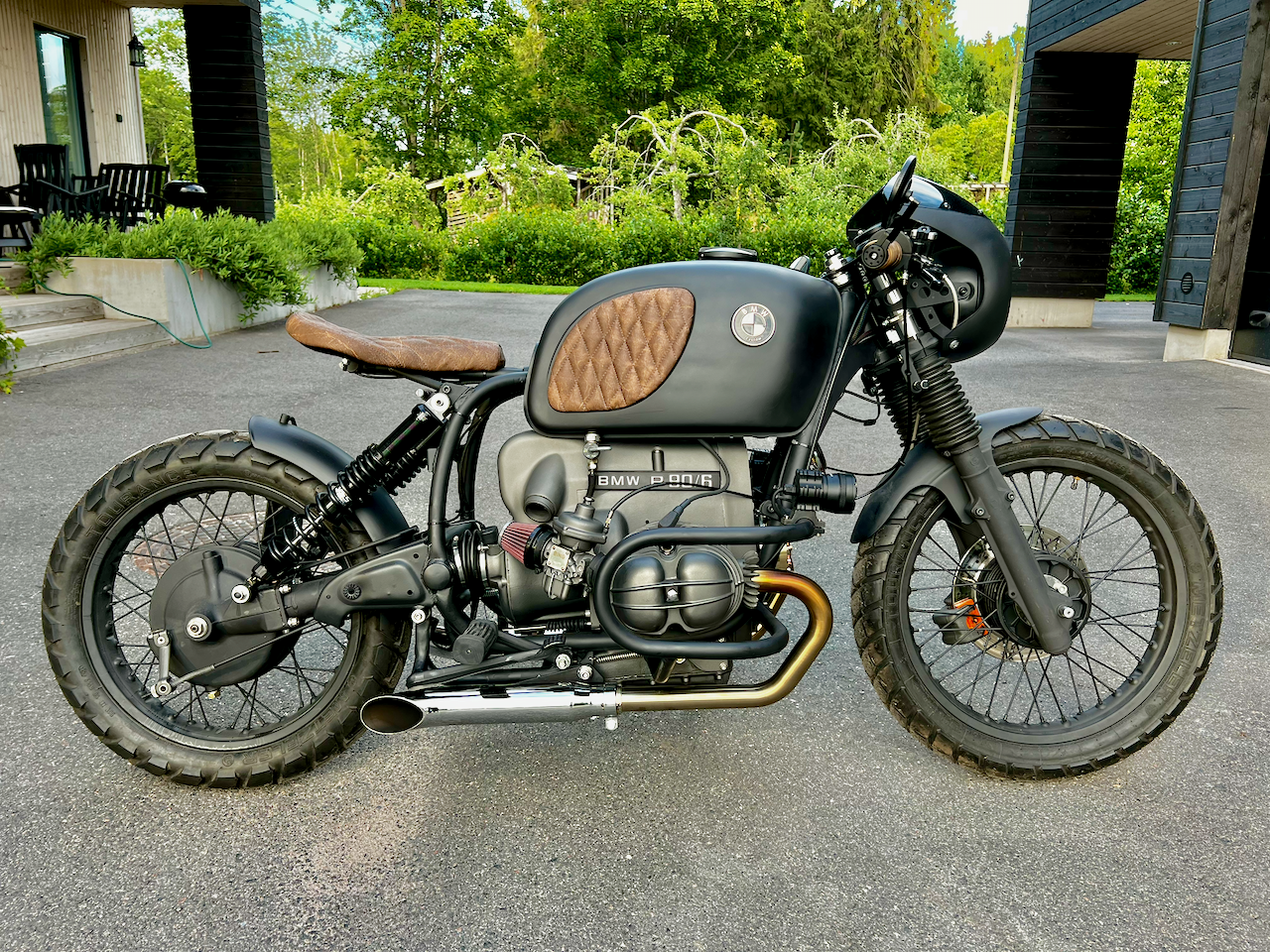
COMPLETE BUILD SPECIFICATION
MACHINE
ENGINE & DRIVETRAIN
ELECTRICAL
FINISHING SYSTEM — CERAKOTE
What This Machine Is
Dark Cray is the proof that the Standard is transferable.
The first build Dark Shadow could be explained as a personal project, a craftsman working to his own specifications on his own machine with no external brief to satisfy. The Standard was self-imposed. The decisions answered only to the builder.
Dark Cray changed the terms. A client’s machine. A client’s preferences incorporated into the design, the cigar-brown leather, the Bobber stance, without compromising the Standard that governed every technical decision. The Cerakote specification was not chosen because the client requested it. It was chosen because it was the correct surface treatment for this machine in this operational environment, and the client’s brief gave no reason to choose anything less.
The problems that arose, the gearbox, the crank, the flywheel, were not the client’s problems to solve. They were the builder’s. The Standard requires that the correct answer be found regardless of the complexity of finding it. The client received a machine rebuilt to a specification that exceeded what he had originally brought to the garage, because the problems encountered during the build made a higher specification not just possible but necessary.
It is a 1973 machine. It operates to a 2023 specification. The gap between those two dates is the work.
“The Standard does not restore. It refines.”
Dark Cray is on the road.
The Standard that built it is documented above.
The ecosystem it belongs to is below.